Navigating the Evolving Landscape: European Private Equity in 2025 and Beyond
June 18, 2025

June 18, 2025
Article by Simon Tyszko, Portfolio Director & Adam Black, Portfolio Analyst at Patria Investments
The European Private Equity (PE) market has navigated a turbulent period marked by the post pandemic M&A surge fueled by cheap debt, followed by inflationary pressures, monetary tightening, and macroeconomic uncertainty. As we progressed through 2024 and into 2025, green shoots of recovery appeared to be emerging, and 2025 promised to be a boom year of catch-up M&A. However, the recent uncertainty surrounding the significant trade tariffs in the US and beyond, has introduced new uncertainties that are causing many in the market to hesitate or postpone planned investment activity.
Buyout Deal Activity: Cautious Recovery
After record dealmaking in 2021-2022, European PE buyout activity hit the brakes following inflationary pressures and geopolitical tension. In the wake of rising rates, investors pulled back from larger transactions leading to a natural shift towards the lower and mid-market, where deals remained more financially manageable. Uncertain market dynamics accelerated changes across industries, pushing PE investment toward resilient, high-growth sectors including technology, healthcare, and consumer staples.
Following the apparent taming of inflation and the European Central Bank’s decision to cut interest rates, these actions served as catalysts for deal-making and sparked a recovery, particularly in the latter part of 2024. Annual European PE deal value increased by 35% year over year (YoY), while the annual deal count rose by 18% YoY, marking the third-best year of dealmaking in European PE after 2021 and 2022[1].
With numerous 2022/23 vintage funds slow off the mark due to unfavorable deal-making environments, coupled with enhanced macroeconomic conditions, many expected these factors to help promote growth in 2025. Yet, this growth comes with caution, as investors try to decipher the second order effects of the newly introduced tariffs. And, possibly more importantly, whether enduring trade deals would emerge to provide the market certainty for businesses to make planned investments with conviction. This, in turn, could provide the stability necessary for investors to pursue M&A.
Exit Activity in 2024 and Q1 2025: Promising Year-End Surge
Exit activity showed signs of confidence regained through 2024 and Q1 25 despite continued weaker IPO markets. Trade sales and secondary buyouts continued to be dominant exit routes, accounting for 87% and 92% in exit value and count in 2024[2], respectively. Exit activity in Europe finished the year higher than the previous two years, thanks in part to a strong Q4. Annual exit value grew 5% YoY while annual exit count grew 19% YoY[1].
Market participants experienced improved exit activity in Q1 25, albeit mostly in a thinly traded market that required careful management of buyers for many processes. In hindsight, sellers who traded in Q4 24 and Q1 25 will feel pleased that they managed to do so in a rare stable market window. The European middle market remains a compelling investment opportunity, even amid market volatility. It has consistently outperformed large and mega-cap LBOs, delivering a 16.9% IRR versus 14.8%, and a 1.8x TVPI versus 1.7x[4]. This outperformance is driven by a broader pool of target companies, more attractive entry valuations, and lower leverage. These factors support stronger value creation and a wider range of exit options, underpinned by strong demand from both financial and strategic buyers. Additionally, the middle market offers enhanced diversification benefits due to its lower correlation with public markets.
Fundraising and Dry Powder: A Selective Market
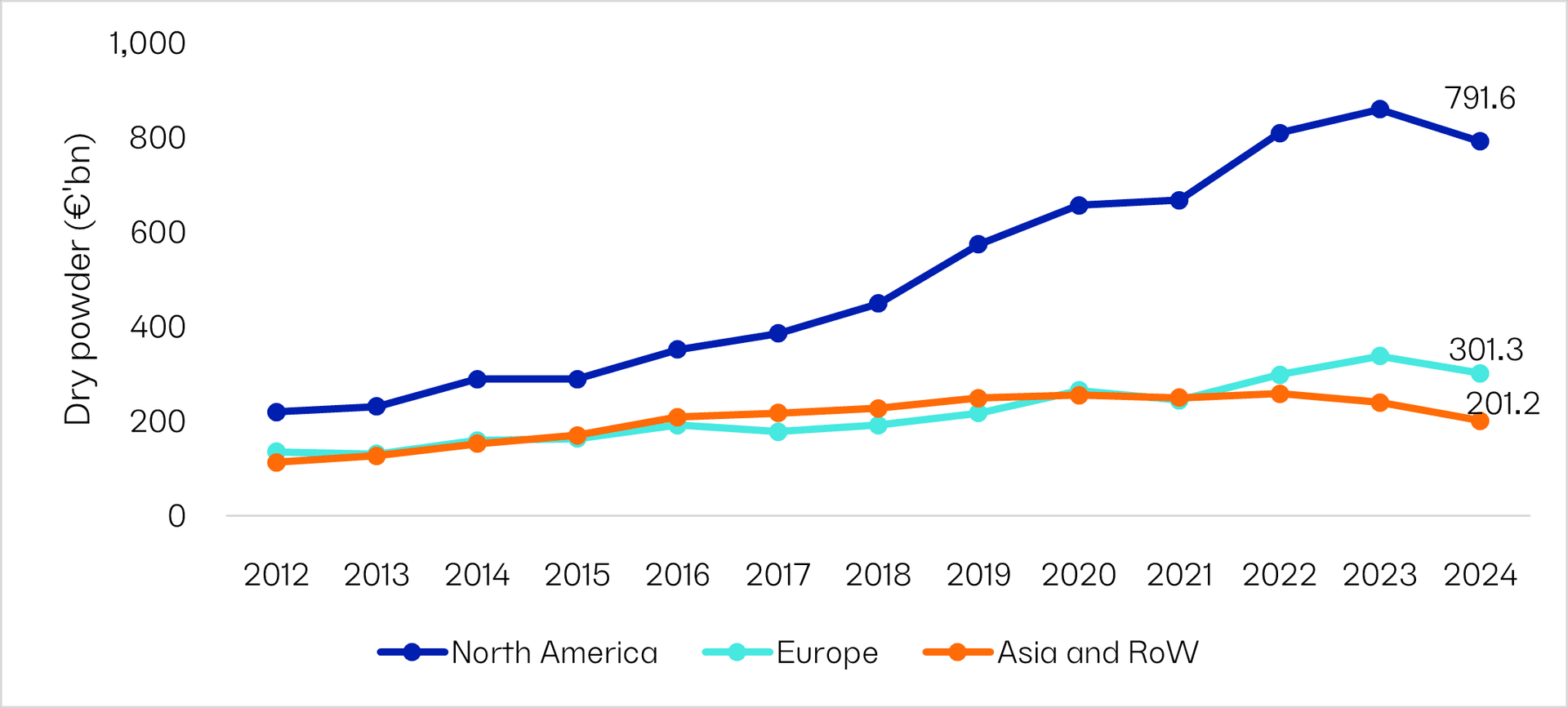
Fundraising in 2024 was divided – established GPs with clear points of difference continued to attract capital, while emerging or less differentiated managers faced challenges. LPs continued to direct capital to firms with strong track records and proven resilience. Despite an average decline of 12% in dry powder across regions during 2024[2], capital remains substantial, and firms are deploying selectively, focusing on value creation rather than relying on multiple expansion.
Secondary Market: New High-Water Mark
Amidst challenging deal and exit environments, rising liquidity pressures on GPs propelled the global secondary market to an unprecedented $171 billion, marking a 54% YoY increase[3]. Continuation funds further emerged as a crucial lifeline for GPs, offering a dual solution by providing liquidity to LPs while retaining top-performing assets. Additionally, LP-led transactions gained renewed traction as investors sought to rebalance their portfolios. The tariff-led uncertainty of Q2 25 appears to be bringing more LP sellers to market. The question facing buyers and sellers is whether the bid/offer spread is too wide for deals to trade. Whilst a strong bid could be found for most LP books of reasonable quality pre-tariffs, this could be a point in the market where sellers have to accept some pricing pain, significant structuring, or an element of contingent consideration to achieve pricing they find acceptable.
The European private equity market has demonstrated notable resilience and adaptability during recent challenges. As we move into H2 2025, a layer of doubt surrounds the industry, with significant uncertainty as to the full impact of recent tariff announcements. GPs are increasingly aware that exposure to these developments varies widely by geography and sector. However, companies with a strong European footprint remain relatively insulated, while service-oriented businesses are less susceptible to direct trade disruptions. In this evolving environment, managers who prioritise fundamental value creation rather than relying on multiples or leverage, will be better equipped to navigate the evolving market dynamics. As LPs grow more discerning, the ability to deliver operational value and mitigate downside risk will be key to sustaining investor confidence and long-term performance.
[1] Pitchbook: European Private Equity Overview, 2024
[2] Preqin
[3] Greenhill - Global Secondary Market Review (FY 2024).
[4] Invest Europe: Europe’s Engine For Growth 2024